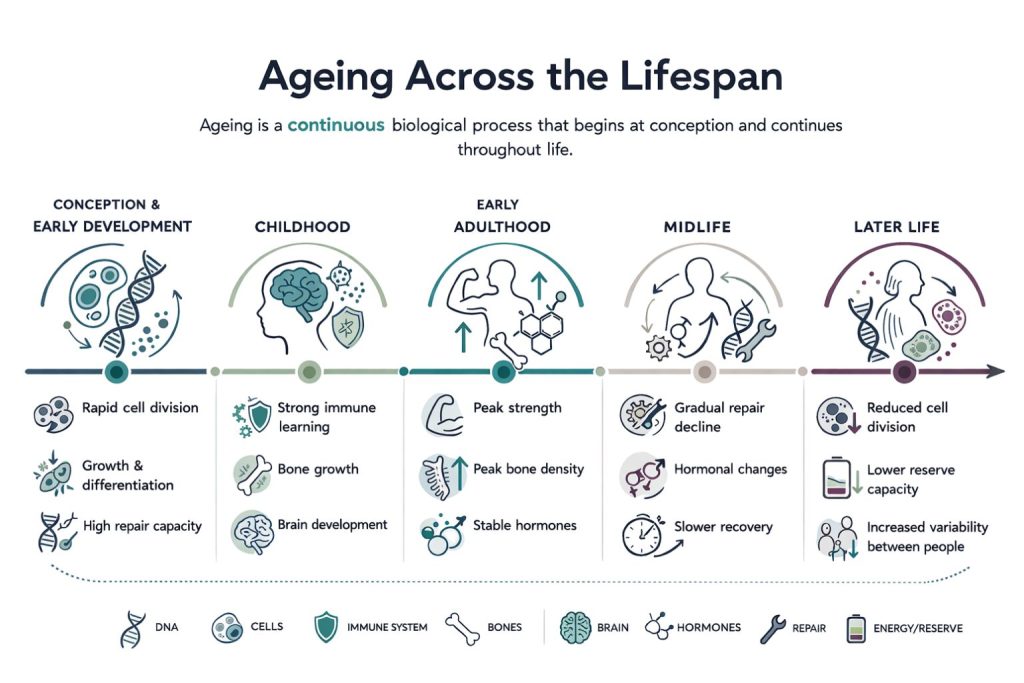
Ageing is often spoken about as if it were a single event that begins at a certain birthday, or as a slow decline that starts in later life. In reality, ageing is a continuous biological process that begins at conception and continues throughout the entire lifespan. Every stage of life, from early development to old age, involves change at the cellular, tissue, and system level. Some of these changes improve function, some maintain stability, and some gradually reduce the body’s ability to repair itself.
Understanding ageing requires separating scientific facts from cultural assumptions. Ageing is not simply getting older, and it is not automatically the same as disease, weakness, or loss of independence. It is a complex, multi-layered biological process influenced by genetics, environment, lifestyle, and chance. This article explains what ageing actually is, how it happens inside the body, and why change across the lifespan is both normal and expected.
Ageing Begins at the Start of Life
From a biological perspective, ageing starts long before wrinkles, grey hair, or reduced strength appear. The process begins as soon as cells start dividing in the developing embryo. Growth, maturation, maintenance, and decline are all part of the same continuum.
During childhood and adolescence, the body is highly efficient at repair and growth. Cells divide rapidly, tissues regenerate easily, and the immune system learns to recognise new threats. Hormonal systems drive development, bones increase in density, muscles grow stronger, and the brain forms new connections at an extraordinary rate.
In early adulthood, the body reaches peak function in many systems. Muscle strength, bone density, reaction time, fertility, and organ performance are often at their highest. However, even at this stage, biological ageing has not stopped. Small changes in DNA, proteins, and cellular structures are already accumulating.
Ageing does not suddenly begin in midlife. It is happening all the time, even when the body appears to be functioning perfectly.
Cells Are at the Centre of Ageing
All ageing ultimately happens at the level of cells. The human body is made of trillions of cells, and each one has to maintain its structure, repair damage, and carry out specialised functions. Over time, this becomes harder.
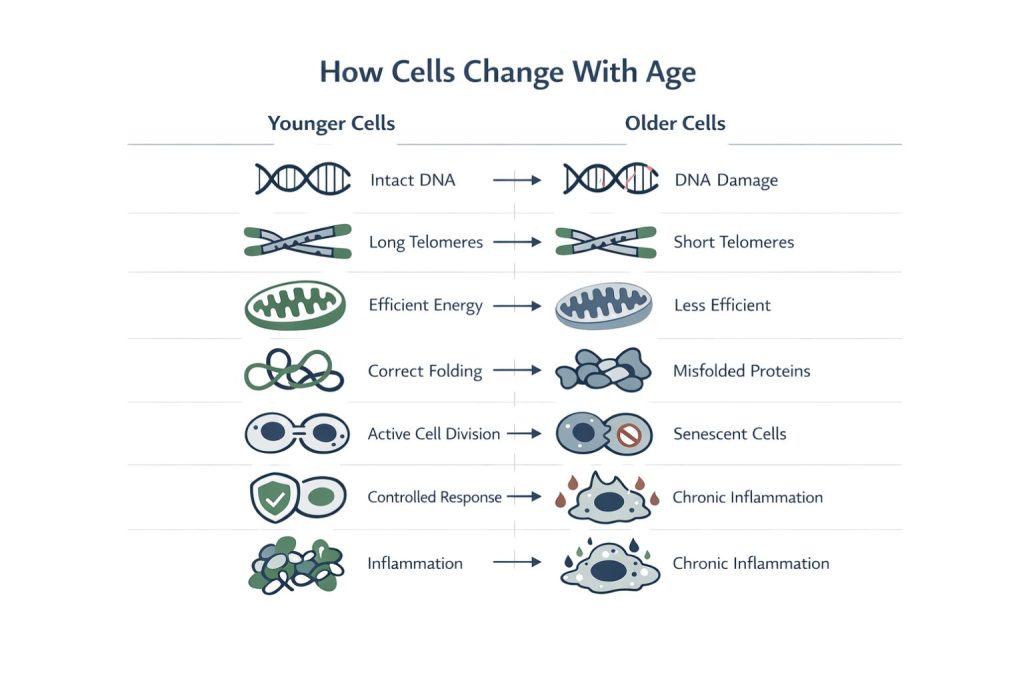
Cells experience constant stress from normal metabolism, environmental exposure, and simple wear from repeated use. Every time a cell divides, its DNA must be copied. Although this process is very accurate, it is not perfect. Small errors accumulate over time.
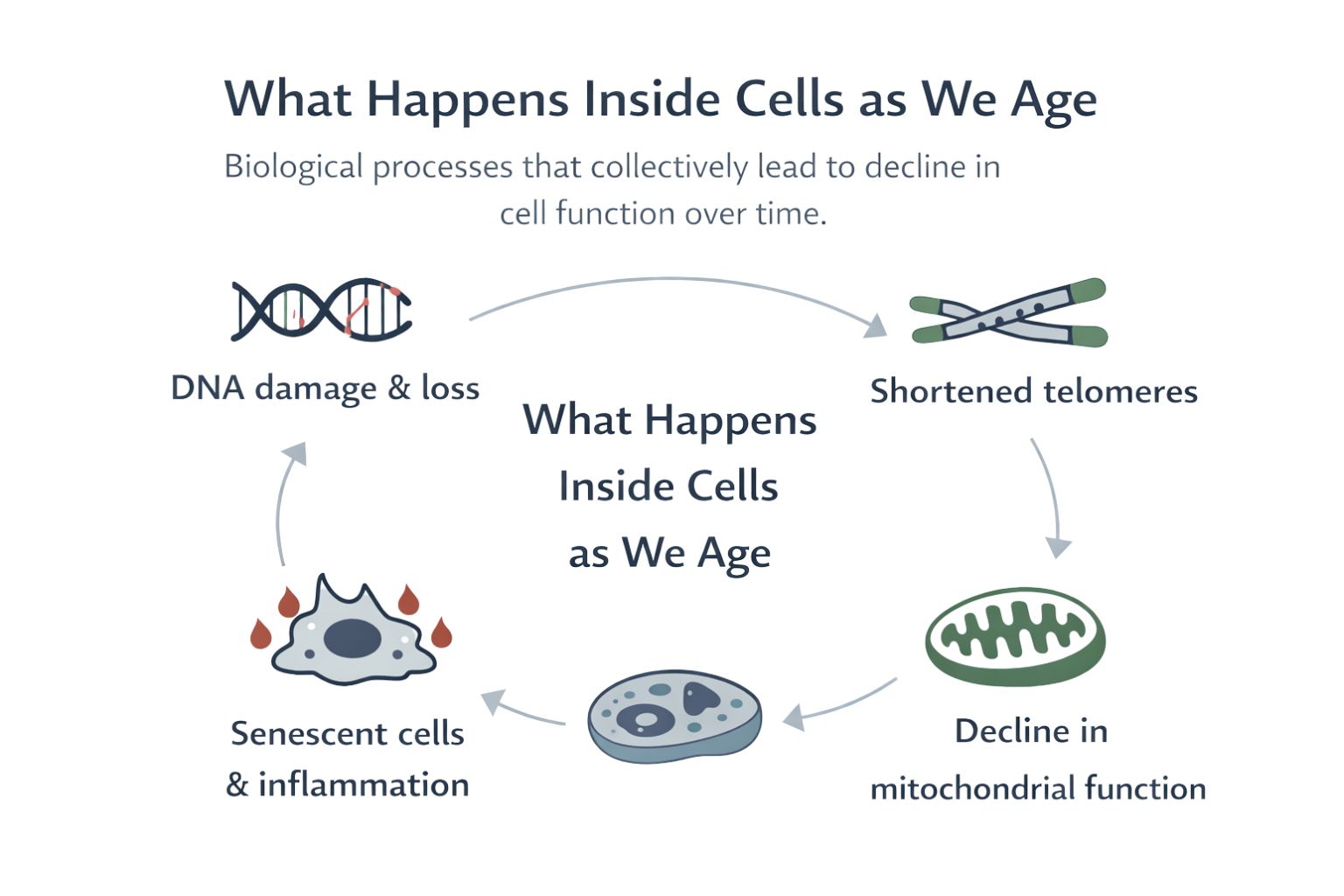
One of the key features of ageing is that cells gradually lose the ability to divide and repair damage. Some cells enter a state called senescence, where they remain alive but no longer function properly. These cells can release inflammatory signals that affect surrounding tissue.
Another important factor is damage to proteins and cellular structures. Proteins must be folded correctly to work, and with age, the systems that maintain protein quality become less efficient. This leads to the build-up of misfolded or damaged molecules.
Mitochondria, the structures that produce energy inside cells, also become less efficient over time. When energy production declines, tissues cannot repair themselves as effectively, and organs may not function as well as they once did.
Ageing is not caused by a single change. It is the result of many small changes happening in every cell over many years.
DNA, Repair, and the Limits of Maintenance
The body has powerful systems designed to prevent damage from accumulating. DNA repair enzymes correct mistakes, antioxidant systems reduce chemical stress, and the immune system removes damaged cells. For much of life, these systems work remarkably well.
However, they are not perfect, and they do not work equally well forever.
DNA damage occurs constantly, both from normal metabolism and from external factors such as radiation, pollution, and toxins. Most damage is repaired, but some remains. Over time, these small errors can affect how cells function.
Another important process involves structures called telomeres. Telomeres sit at the ends of chromosomes and protect DNA during cell division. Each time a cell divides, telomeres become slightly shorter. Eventually, they become too short for the cell to divide safely, and the cell stops replicating.
This is one reason why tissues that rely on frequent cell division, such as skin, blood, and the lining of the gut, show clear signs of ageing over time.
Ageing does not happen because the body suddenly fails. It happens because maintenance systems gradually become less efficient.
The Role of the Immune System in Ageing
The immune system changes throughout life, and these changes are an important part of ageing.
In early life, the immune system is still learning. It gradually builds a memory of infections and develops the ability to respond quickly to familiar threats. In adulthood, immune responses are usually strong and well regulated.
Later in life, the immune system becomes less responsive. This process is sometimes called immunosenescence. The body may respond more slowly to infections, vaccines may be less effective, and inflammation may become more common.
At the same time, the immune system can become less precise. Instead of responding only to real threats, it may produce low-level inflammation even when no infection is present. This chronic inflammation can contribute to many age-related conditions.
These changes do not mean the immune system stops working. They mean the balance between defence, repair, and regulation becomes harder to maintain.
Hormones and Biological Signalling
Hormones are chemical messengers that coordinate many functions in the body. They regulate growth, metabolism, reproduction, mood, sleep, and energy use. Hormonal systems also change across the lifespan.
During puberty, hormone levels rise dramatically, driving growth and sexual development. In adulthood, hormone levels tend to stabilise. Over time, some hormones decline, while others change in pattern rather than amount.
For example, growth hormone levels gradually fall with age. This can affect muscle mass, fat distribution, and bone density. Sex hormones also change. In women, menopause marks a major shift in oestrogen levels. In men, testosterone tends to decline more gradually.
These changes are a normal part of ageing. They do not automatically mean illness, but they can influence how the body feels and functions.
Hormonal change is one of the reasons ageing affects many systems at once.
Ageing Is Different in Every Tissue
Not all parts of the body age at the same rate. Some tissues regenerate quickly, while others have very limited repair capacity.
Skin renews itself constantly, but over time collagen production decreases, leading to thinner, less elastic tissue. Muscles can remain strong with use, but muscle mass tends to decline if activity decreases. Bone density reaches a peak in early adulthood and may gradually fall later in life.
The brain changes as well, but not always in the ways people expect. Some cognitive abilities, such as processing speed, may slow with age. Others, such as vocabulary and accumulated knowledge, often remain stable or even improve.
The heart, lungs, kidneys, and liver all continue to function throughout life, but they may have less reserve capacity. This means the body can still work normally day to day, but may recover more slowly from illness or stress.
Ageing does not affect every system equally, and it does not affect everyone in the same way.
Ageing and Disease Are Not the Same Thing
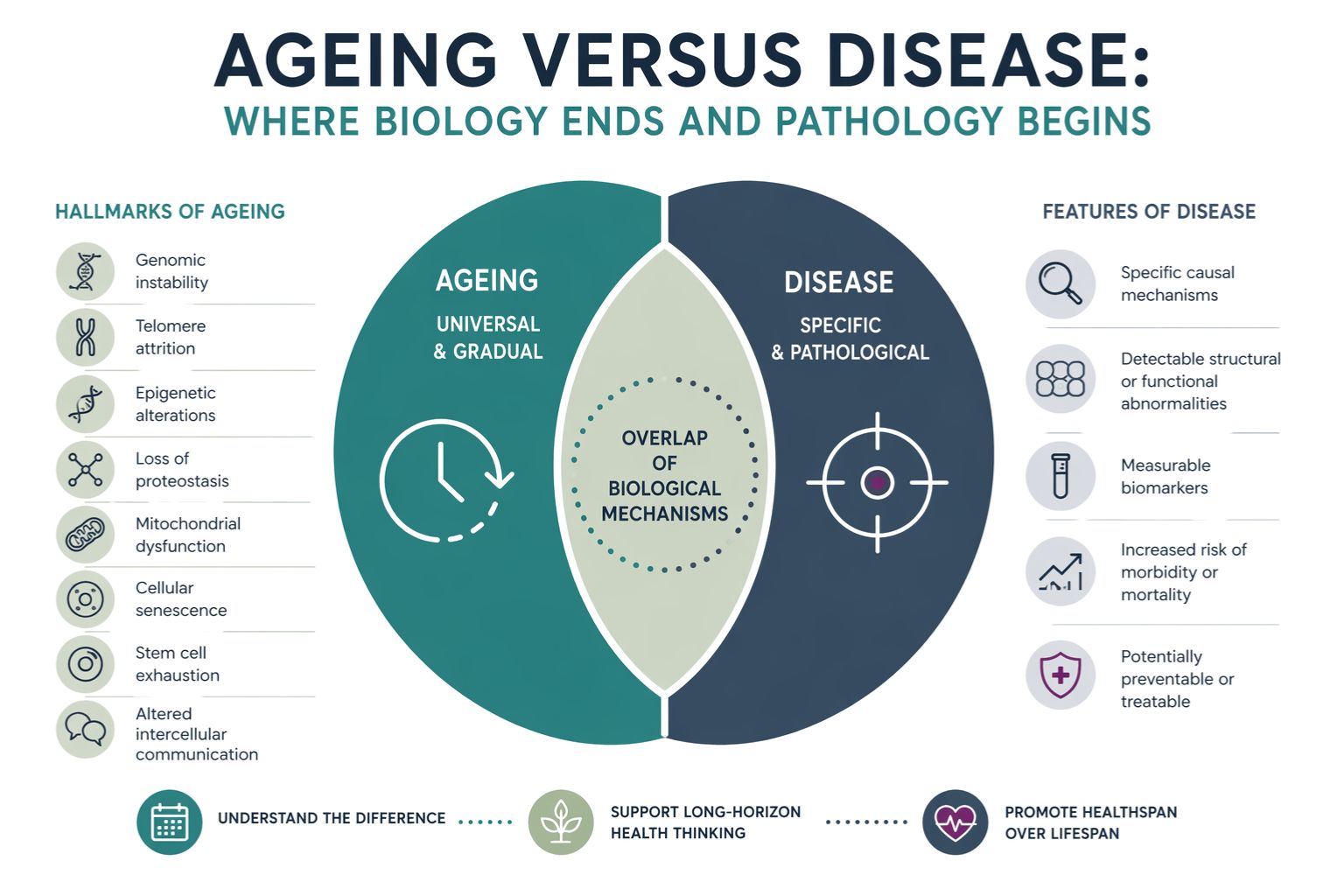
One of the most common misunderstandings about ageing is the belief that growing older automatically means becoming ill. While the risk of many diseases increases with age, ageing itself is not a disease.
Conditions such as heart disease, cancer, diabetes, and dementia are influenced by ageing, but they are not caused by age alone. Genetics, environment, lifestyle, and chance all play a role.
Many people remain healthy and active well into later life, while others develop health problems earlier. This variation shows that ageing is not a fixed path.
Understanding the difference between normal biological change and disease is important. It allows people to focus on maintaining health, rather than assuming decline is unavoidable.
Lifestyle, Environment, and Chance
Ageing is shaped by more than biology alone. The environment a person lives in, the food they eat, the amount of physical activity they do, their exposure to stress, and even social connections can all influence how the body changes over time.
Regular physical activity helps maintain muscle strength, bone density, and cardiovascular health. Good nutrition supports repair processes. Sleep allows the brain and body to recover. Avoiding toxins such as tobacco reduces long-term damage.
However, lifestyle is only part of the story. Genetics also plays a role, and so does chance. Some people develop age-related conditions despite healthy habits, while others remain well even with risk factors.
Why Understanding Ageing Matters
Misunderstanding ageing can lead to unnecessary fear, unrealistic expectations, or misleading claims about treatments and products. Many industries promote the idea that ageing can be stopped, reversed, or avoided entirely. Scientific evidence does not support these claims.
Ageing can sometimes be slowed in specific ways, and health can often be improved, but the underlying biological process continues throughout life.
Understanding what ageing actually is allows people to make better decisions about health, medical care, and lifestyle. It also helps avoid the idea that growing older means losing value, ability, or independence.
Ageing is a natural process shared by every human being. It reflects the fact that living systems change over time.
A Lifelong Process, Not a Single Moment
There is no single point at which ageing begins, and no clear line between young and old. Biological change happens gradually, influenced by countless small events inside cells and tissues.
From early development to late life, the body is constantly balancing growth, repair, and decline. For many years, repair keeps pace with damage. Later, repair becomes less efficient, and change becomes more visible.
Understanding ageing as a lifelong biological process gives a clearer and more accurate picture than the idea of sudden decline. It shows that ageing is not a failure of the body, but a consequence of how living systems work.
Every stage of life involves change. Ageing is simply the continuation of that change across time.