
Hitting the big 40 is often seen as a milestone of wisdom and career peak, but biologically, your body starts playing by a different set of rules. One of the most significant changes happening under the surface is the gradual decline of skeletal muscle mass. If you’ve noticed that your favourite pair of jeans fits differently: or that you’re feeling a bit more "fragile" than you did a decade ago: you aren’t imagining things.
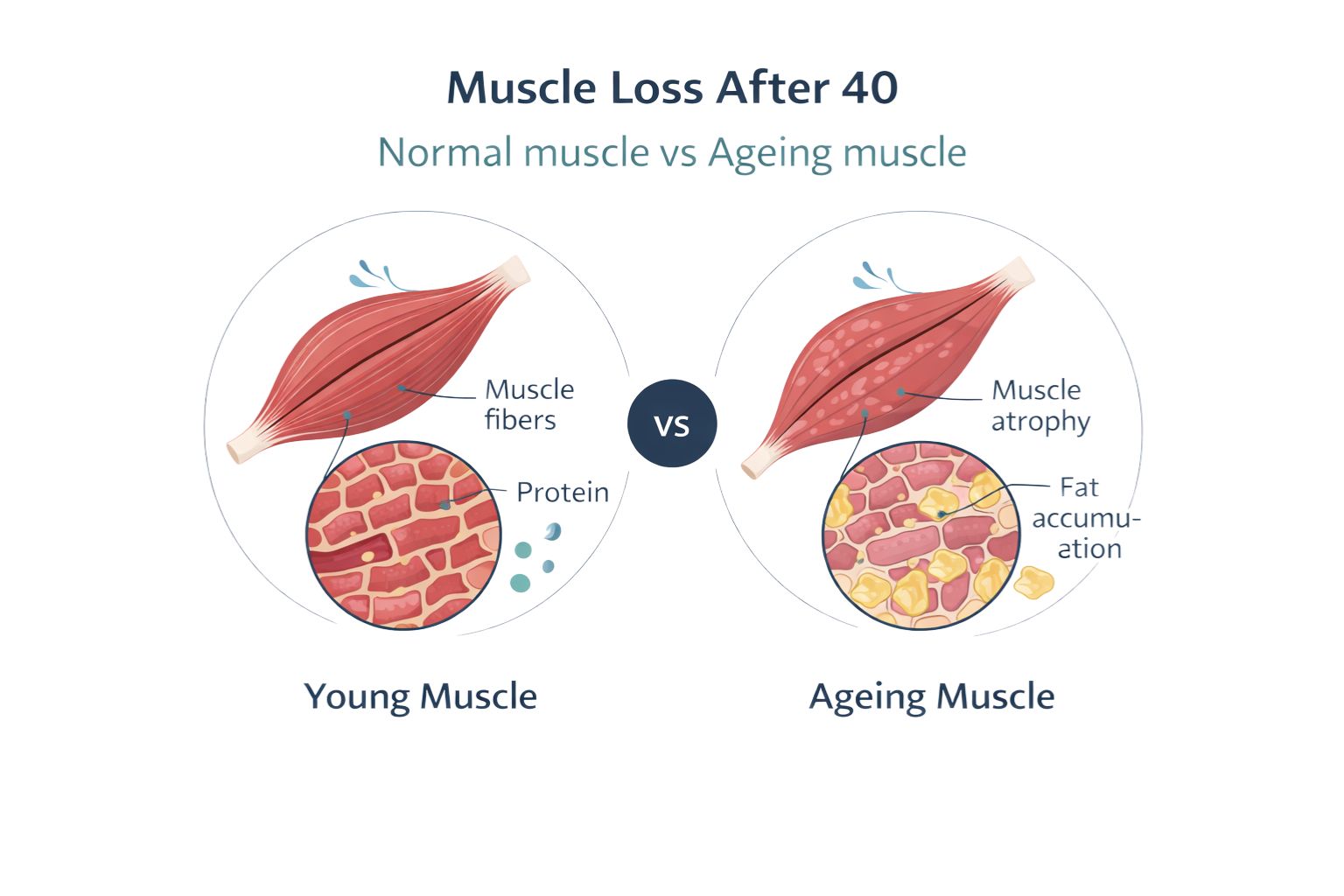
In the medical world, we call this involuntary loss of muscle sarcopenia. Research suggests that without active intervention, adults can lose between 3% to 8% of their muscle mass per decade after the age of 30, a rate that accelerates significantly once you cross the 60 year mark. By the time someone reaches 70, they may have lost up to 30% of the muscle mass they had in their prime.
At Understanding Ageing, we believe that knowledge is the best tool for longevity. While muscle loss after 40 is a biological reality, it doesn’t have to be your destiny. However, many people who think they are doing the right things to stay fit are actually making critical errors that hinder their progress.
Let’s dive into the most common mistakes people make when trying to maintain strength and how you can fix them.

1. You’re Prioritizing Cardio Over Resistance Training
It’s the classic "get healthy" move: you turn 40, decide to get fit, and immediately sign up for a half-marathon or spend an hour every day on the treadmill. While cardiovascular health is vital for your heart and lungs, cardio alone will not stop the clock on muscle loss.
In fact, excessive steady state cardio without any strength work can sometimes lead to further muscle wasting. Your body is an efficiency machine, if you’re doing long distance running without feeding your muscles, your body may break down muscle tissue for energy.
To combat muscle loss after 40, resistance training must be the foundation of your routine. This doesn't mean you have to become a bodybuilder, but you do need to challenge your muscles against a force: whether that’s weights, resistance bands, or your own body weight.
2. The "Ego Lifting" vs. Quality Movement Trap
On the flip side of the cardio mistake is the "I can still lift what I did at 25" mistake. Many people entering their 40s and 50s hit the gym with the same intensity and lack of form they had in their youth.
As we age, our tendons and ligaments become less elastic, and our joints require more care. "Ego lifting": prioritizing the weight on the bar over the quality of the movement: is a fast track to injury. An injury at 40 takes longer to heal than it did at 20, and the forced inactivity during recovery leads to rapid muscle atrophy.
The Fix: Focus on the "mind-muscle connection." Slow down your repetitions. Focus on the eccentric (lowering) phase of the lift, which is where a lot of muscle growth is stimulated. If you can’t control the weight through the full range of motion, it’s too heavy.
3. You’re Not Eating Enough Protein (or Distributing It Poorly)
This is perhaps the most common mistake we see at Understanding Ageing. Most adults over 40 are drastically under consuming protein. As we age, our bodies become less efficient at processing protein into muscle: a phenomenon known as "anabolic resistance."
You can’t eat the same amount of protein you did in your 20s and expect the same results. To maintain muscle, you should aim for approximately 1.2 to 1.6 grams of protein per kilogram of body weight. For many, that means 25 – 40 grams of high-quality protein at every meal.
Another mistake is "backloading" your protein: eating a piece of toast for breakfast, a salad for lunch, and a massive steak for dinner. Your body can only process a certain amount of protein for muscle synthesis at one time.
Pro Tip: Spread your protein intake evenly throughout the day to keep your "muscle building switch" turned on.
4. Ignoring the Importance of Recovery and Sleep
In your 40s, your "recovery budget" shrinks. You can no longer get away with four hours of sleep and a stressful workday followed by a high intensity workout.
Muscle isn't built in the gym; it’s built while you sleep. This is when your body releases growth hormones and repairs the micro tears created during your workout. If you are chronically sleep deprived, your cortisol (stress hormone) levels rise, which actively promotes muscle breakdown and fat storage around the midsection.
If you’re feeling constantly sore or exhausted, you’re likely overtraining or under recovering. Understanding the biological boundaries of your body is key to staying consistent.
5. You’ve Stopped "Progressive Overload"
If you’ve been lifting the same 5kg dumbbells for the last five years, your muscles have no reason to grow or even stay. Your body is incredibly adaptive; once it realizes it can handle a certain level of stress, it plateaus.
To fight muscle loss after 40, you must practice progressive overload. This means gradually increasing the difficulty of your workouts. This could mean:
- Adding a small amount of weight.
- Doing one extra repetition.
- Decreasing your rest time between sets.
- Improving your form to make the movement harder.
Without progression, you aren't just staying the same: you are likely losing ground to the natural ageing process.
6. Neglecting Mobility and "Corrective" Exercises
Many people over 40 focus solely on the "mirror muscles": chest, arms, and shoulders: while ignoring the stabilizers that keep them functional. Neglecting your core, glutes, and upper back leads to poor posture and imbalances.
Eventually, these imbalances lead to chronic pain in the lower back or knees, which causes you to stop exercising altogether. This "vicious cycle of inactivity" is the primary driver of sarcopenia.
Incorporating mobility work (like yoga or dedicated stretching) and corrective exercises (like face pulls or bird dogs) ensures that your "chassis" can handle the "engine" you are building. It’s about staying functional, not just looking fit. You can learn more about identifying these shifts in our guide on what ageing actually is.
7. Waiting Too Late to Take Symptoms Seriously
The final mistake is the "it’s just a part of getting old" mindset. While some muscle loss is natural, rapid declines in strength, balance issues, or extreme fatigue are red flags.
If you find yourself struggling to get out of a chair, losing your balance frequently, or noticing your grip strength has vanished, you might be experiencing more advanced sarcopenia. These aren't just "aging problems": they are clinical symptoms that require a shift in your lifestyle and potentially a conversation with a healthcare provider.
We’ve put together a specific resource on 5 ways to spot sarcopenia symptoms to help you distinguish between normal ageing and something that needs more attention.
Why This Matters for Your Future
Muscle is more than just a way to look good at the beach. It is your "metabolic body armor."
- Blood Sugar Regulation: Muscles are the primary site for glucose disposal. More muscle means better insulin sensitivity.
- Bone Density: Pulling on bones through strength training increases bone mineral density, protecting you from osteoporosis.
- Metabolism: Muscle is metabolically expensive. The more you have, the more calories you burn at rest.
- Independence: Strength is the difference between living independently at 85 and needing assisted care.
At Understanding Ageing, our goal is to help you navigate these transitions with confidence. By avoiding these seven common mistakes, you aren't just fighting muscle loss after 40: you are investing in a future where you remain mobile, energetic, and strong.
If you’re looking for more practical advice on maintaining your body as you age, check out our Muscles, Bones, and Joints section or browse our latest guides for evidence-based tips on healthy longevity.

Summary Checklist:
- Lift Weights: At least 2-3 times a week.
- Eat Protein: 25 - 40g per meal.
- Prioritize Sleep: Aim for 7-9 hours.
- Check Your Ego: Focus on form over heavy weight.
- Stay Mobile: Don't skip the warm-up or stretching.
- Progress: Always look for small ways to challenge yourself.
Ageing is inevitable, but how you age is largely within your control. Let's make sure those muscles stay right where they belong!