A menu looks perfectly readable in daylight, yet in a dim restaurant the words seem to shrink. The reader holds it farther away, searches for a brighter corner, and wonders whether this is just what happens with age. The same uncertainty can appear while driving after dark, recovering from oncoming headlights, or recognising a familiar face across a room.
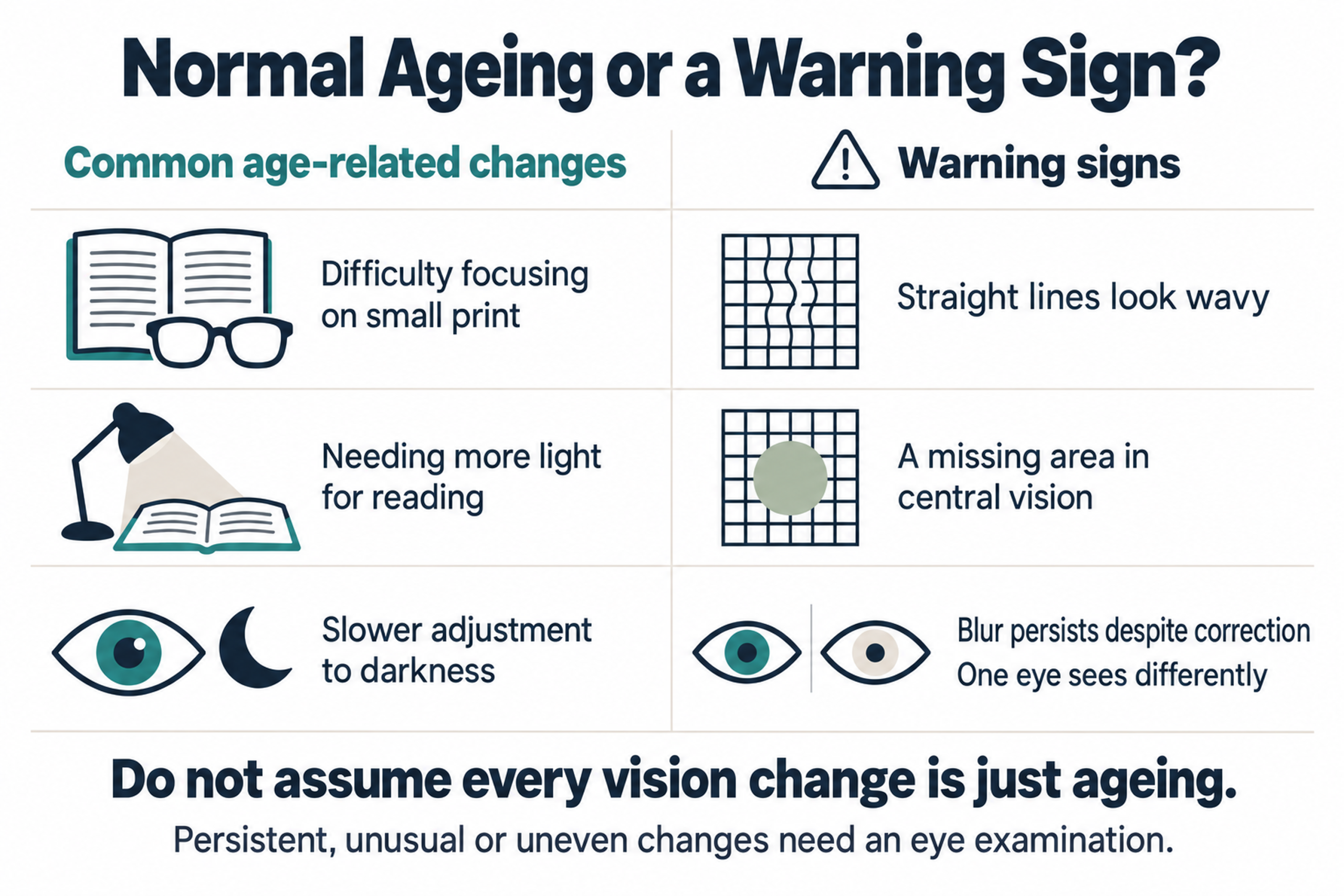
Some vision changes with age are normal. The eye's focusing system becomes less flexible, and several visual functions become less efficient. But ageing itself shouldn't be used to explain every new symptom. A gradual need for reading glasses is different from distorted straight lines, a missing area of vision, or sudden loss in one eye.
The useful question isn't only, “Is this common?” It's also, “Is this change stable, gradual, and improved with the right correction, or is it worsening, uneven, distorted, painful, or sudden?” That distinction helps people stay reassured without overlooking treatable eye disease.

How Ageing Changes the Eyes
A menu that seems readable in daylight can become difficult in a dim restaurant. You may move closer to the lamp, enlarge the text on your phone, or reach for reading glasses. Similar changes appear when you drive at night and need longer to recover from oncoming headlights. These experiences often reflect how ageing affects focusing and the way the visual system handles light.
The eye's focusing lens gradually becomes stiffer, so close work requires more effort. Reading menus, checking messages, sewing, or examining small print may feel tiring even when distance vision remains clear. Better lighting and the correct prescription can make these tasks easier.
Ageing also affects visual performance beyond focus. Contrast sensitivity, dark adaptation, visual acuity, and the effective visual field may decline without a specific eye disease, as described in this ophthalmic review of normal visual ageing. In daily life, that can mean grey lettering is harder to distinguish from a pale background, a step is less visible in a shadow, or headlight glare lingers after the car has passed.
These changes are functional, not merely clinical. They can alter how confidently someone reads a restaurant bill, crosses a dim hallway, or judges the edge of a kerb. Brighter, well directed light, larger print, and an updated prescription may help.
Why “just ageing” can mislead
A new focusing difficulty is often benign, but persistent blur deserves an eye examination. Clouding of the lens, retinal disease, or optic nerve damage can also affect sight. Age related macular disease becomes more common later in life. A UK study estimated late age related macular degeneration in 2.4% of people aged 50 and over, 4.8% among people aged 65 and over, and 12.2% among people aged 80 and over, as reported in the British Journal of Ophthalmology.
Those figures describe a UK population, yet the practical lesson is broader. Do not dismiss a persistent change just because it occurs with age.
Gradual and correctable blur often fits normal ageing. Distorted, one sided, sudden, painful, or progressively worsening vision needs professional assessment.
This distinction provides reassurance without false certainty. Ordinary presbyopia should not cause alarm, while a treatable eye condition should not be missed because every new symptom is attributed to ageing.
Typical Vision Shifts You Can Expect
The most familiar age related change is presbyopia. The eye contains a clear lens that changes shape to focus at different distances. With age, that lens becomes less flexible, so it can't increase its focusing power as easily for close work.
Presbyopia typically starts in the 40s. Someone may see distant objects clearly but struggle with small print, hold a phone farther away, or need reading glasses for the first time. This is a normal focusing change, not a sign that the eye is failing.
A simple explanation appears in this NHS linked guide to presbyopia. Broader context about biological ageing is also available in this guide to biological change across the lifespan.
Why low light feels different
Ageing affects more than focusing. The visual system may become less sensitive to contrast, so an object that stands out clearly in bright conditions can blend into its surroundings in a dim room. Dark adaptation can also become less effective, meaning the eyes take longer to adjust when moving from a bright space into darkness.
This explains several familiar experiences:
- Reading needs more light: A larger, evenly lit page is easier to interpret than faint print in a shadow.
- Headlights feel harsher: Glare and light scatter can reduce the useful contrast around bright sources.
- Night driving feels slower: The eyes may take longer to recover after exposure to bright headlights.
- Steps and kerbs are harder to judge: Lower contrast and changes in depth perception can make obstacles less obvious.
The camera analogy helps. The lens becomes less flexible, like a camera lens that can't refocus quickly at close range. The eye's light handling system also becomes less efficient, so the same environment may provide less usable information than it once did.
What should remain reassuring
Normal age related changes tend to develop gradually and affect both eyes in broadly similar ways. They often improve with an accurate prescription, better lighting, increased print size, or reduced glare.
That doesn't mean every gradual symptom is harmless. A new prescription can improve clarity while an eye disease continues underneath, which is why routine eye care remains important. A person shouldn't keep increasing the strength of reading glasses if one eye sees differently, lines look bent, or a central patch is missing.
When Gradual Blur Signals Underlying Disease
You may still read a menu, recognise a face, or drive familiar roads, yet notice that colours look duller or one eye seems different. Those details matter. Blur becomes more concerning when it has a distinctive quality rather than just making small print harder to focus on. Washed out colours, increasing glare, halos, distortion, blind spots, or a persistent difference between the eyes warrant an eye assessment.
A cataract forms when the normally clear lens becomes cloudy. The lens acts like a window inside the eye. As it loses clarity, it scatters and filters light before that light reaches the retina. You may notice faded colours, glare, poorer night vision, double vision in one eye, or blur that a new prescription does not fully correct. Repeated prescription changes without restored visual quality suggest that focusing is not the only issue.
AMD affects the macula, the retinal area responsible for detailed central vision. It can interfere with reading, recognising faces, or seeing the centre of a road sign while side vision remains relatively useful. The NHS describes this pattern and related vision loss and AMD. Straight lines that become bent or wavy deserve prompt assessment rather than stronger reading glasses.
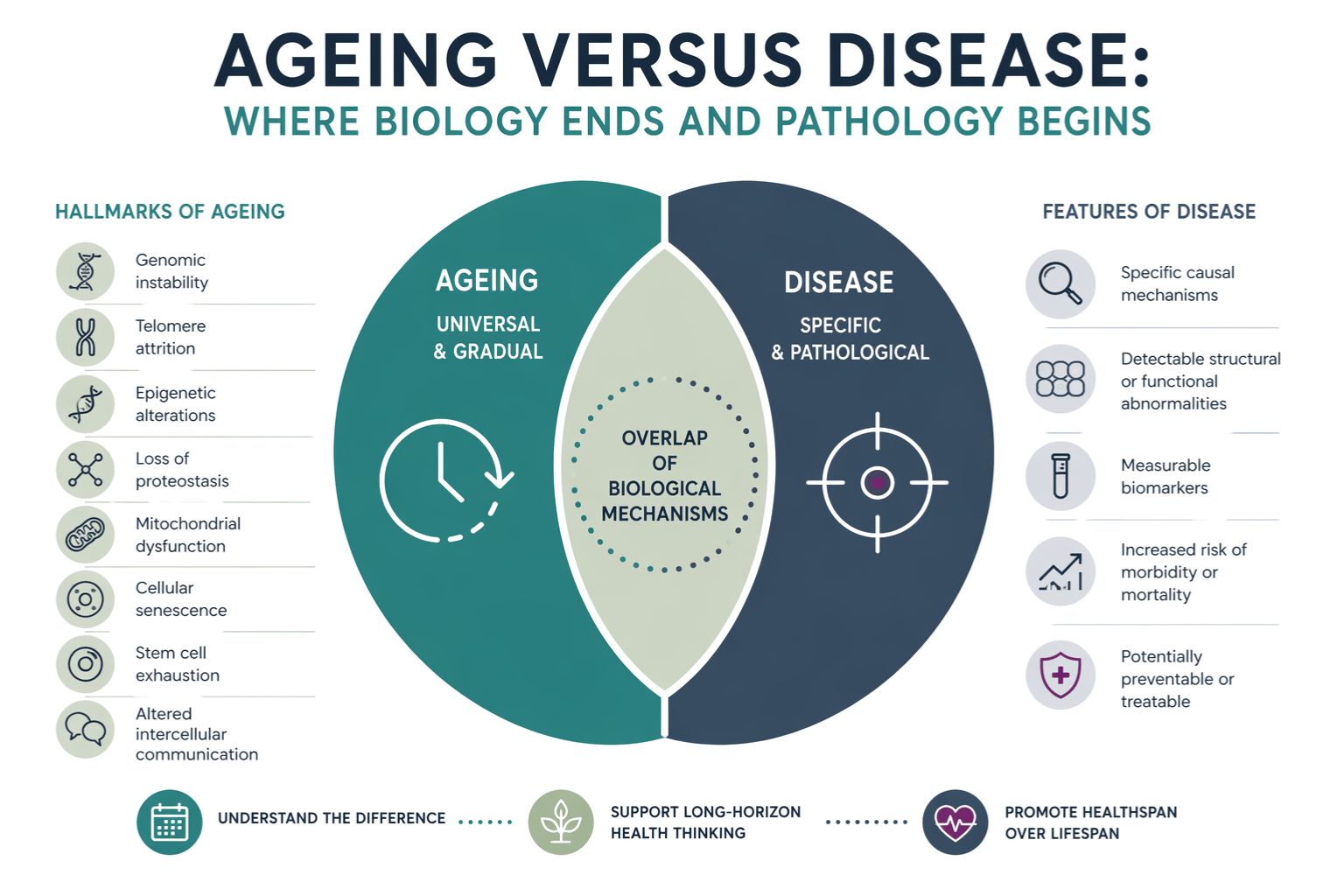
For a clearer explanation of how ageing differs from disease where biology ends and pathology begins, compare the symptom's behaviour, not just its presence.
A practical comparison
| Symptom | Normal Ageing | Potential Disease Indicator |
|---|---|---|
| Near blur | Small print becomes harder to focus on and improves with reading correction | Blur remains despite correction or affects one eye markedly |
| Low light difficulty | More light is needed for reading and close work | Night vision worsens with glare, halos, faded colours, or persistent blur |
| Straight lines | Detail may be harder to resolve in poor lighting | Lines look bent, wavy, broken, or distorted |
| Central vision | Fine detail may be less comfortable | A central blank, grey, or blurred area develops |
| Side vision | Depth and obstacles may be harder to judge | Repeated missing areas or narrowing peripheral vision appears |
| Double vision | Temporary blur can occur with visual fatigue | Persistent double vision in one eye needs assessment |
Why early disease can be deceptive
Glaucoma may damage the optic nerve without obvious early symptoms. Loss can begin in peripheral vision, where the brain often fills in missing information during ordinary activities. You may therefore feel that vision is fine while damage continues. Routine examinations can detect changes that daily tasks conceal.
Diabetic eye disease can also develop before noticeable blur. Alterations in the retina's small blood vessels may affect vision later, so clear sight does not prove that the retina is healthy. Anyone with diabetes needs eye care based on their condition and local clinical guidance, not only on how clear vision feels.
Historical health data from England show the scale of age related vision care. In 2019/20, England recorded 9 million vision outpatient attendances, 3.4 million individual patients, and 2.2 million first attendances, along with more than 380,000 cataract surgeries in people aged 65 and over, according to the Vision Atlas from Public Health England. These figures do not predict your personal risk. They reinforce why persistent functional changes deserve assessment, even when vision has not suddenly disappeared.
Red Flags That Require Immediate Care
Normal presbyopia develops gradually. It doesn't suddenly remove vision, create a dark curtain, or cause severe pain with nausea. Acute symptoms need a different response from a routine appointment for updated reading glasses.
Seek urgent assessment for sudden changes
A sudden shower of new floaters, especially when accompanied by flashes of light, can indicate traction on the retina or a retinal tear. A dark curtain, veil, or shadow moving across the field of vision may signal retinal detachment. These symptoms require urgent eye assessment rather than observation at home.
Sudden painless vision loss in one eye also needs immediate medical attention. The cause may involve the retina, optic nerve, or blood supply, and the person shouldn't drive themselves if vision is impaired.
Severe eye pain with nausea, blurred vision, or marked halos around lights can occur with acute angle closure glaucoma. This is an emergency. The appropriate action is to contact local emergency services, an emergency department, or an urgent eye care service immediately, depending on the healthcare system.
Routine or urgent?

A person shouldn't wait for pain before taking sudden visual loss seriously. Retinal problems and some vascular events can be painless, while glaucoma may be painful in its acute form but quiet in other forms.
Adapting Your Environment for Better Sight
A menu that once looked clear may now need stronger lighting, and headlights that felt manageable can produce distracting glare at night. Ageing eyes often need clearer visual information for close work, navigation, and driving. Glare sensitivity, poorer night vision, and difficulty judging depth and obstacles can occur as part of normal ageing, as noted earlier in the ophthalmic review of visual ageing.
Good lighting means placing illumination where the task happens, limiting reflections, and improving contrast. Filling every room with harsh brightness can increase glare rather than improve sight.
Improve close work first

- Use task lighting. Aim an adjustable desk lamp at the page, not at the eyes. Change its angle if reflections appear.
- Choose even illumination. A bright screen in a dark room can feel uncomfortable. Softer background lighting helps reduce that difference.
- Increase text size before increasing lens strength. Enlarging print may improve comfort without changing a prescription.
- Raise contrast. Dark lettering on a pale, non reflective background is easier to interpret than faint, low contrast text.
- Keep lenses clean. Smears scatter light and can worsen glare around screens and lamps.
Make screens and driving more comfortable
Position screens to keep windows and overhead lights out of the reflection. Set screen brightness to match the room instead of leaving it at maximum, and change viewing distance regularly during close work.
For driving, an eye care professional can check whether a new distance prescription, an anti reflective coating, or another lens design may help. These measures cannot make unsafe night vision safe. Persistent halos, glare, or trouble seeing pedestrians should lead to an eye examination and a careful decision about driving.
For broader practical advice, explore these evidence based ageing guides. Environmental changes can support independence, but new, worsening, or uneven vision still requires professional assessment.
Protecting Long Term Eye Health
Eye health is tied to the health of the whole body. The retina contains a fine network of blood vessels, so long term problems affecting circulation can also affect retinal tissue. Managing diabetes, blood pressure, and cardiovascular risk supports the conditions in which the retina and optic nerve function.
This doesn't mean lifestyle choices can prevent every eye condition. Cataracts, glaucoma, and AMD have multiple influences, including age, genetics, and previous eye events. Still, daily health decisions can reduce avoidable strain on the visual system and make treatable disease easier to detect and manage.
Connect systemic care with eye care
People living with diabetes should follow their clinical team's advice for blood sugar monitoring and retinal screening. High blood sugar can affect retinal blood vessels, sometimes before a person notices visual symptoms. Blood pressure management also matters because small vessels supplying the eye are sensitive to vascular stress.
Smoking cessation is another important protective step. Tobacco exposure is associated with poorer vascular health and can add avoidable risk to conditions affecting the macula and optic nerve. Stopping can be difficult, but structured support from a healthcare professional improves the chance of maintaining the change.
Protect the macula and the lens
Outdoor protection should include sunglasses that provide appropriate ultraviolet protection and a hat or shade when practical. This reduces exposure to intense sunlight, although it doesn't remove the need for eye examinations.
A varied diet is more useful than a single “eye food”. Dark leafy vegetables and other colourful plant foods provide nutrients involved in retinal function, while fish can contribute beneficial fats. Lutein and zeaxanthin are concentrated in the macula, but supplements shouldn't be started casually, especially when a person has other medical conditions or takes regular medicines.
A balanced plan matters more than a miracle ingredient: protect the eyes from avoidable exposure, manage systemic conditions, avoid smoking, and keep scheduled eye appointments.
Sleep, movement, and metabolic health also influence how consistently people manage chronic conditions and notice changes in daily function. The relationship between metabolism and ageing is explored in this guide to hormones and metabolism, but practical medical advice should come from the person's own healthcare team.
Making the Most of Your Eye Examinations
You may notice that reading a menu takes longer, faces look less distinct at dusk, or headlights leave your vision washed out. These changes deserve more than a new pair of glasses if they continue, worsen, or affect confidence. A basic sight test measures how clearly you read at distance or close range. A full eye examination also assesses the cornea, lens, retina, optic nerve, eye pressure, and visual fields, with further tests chosen according to your symptoms and risk.
Describe what has changed in daily life, rather than saying only that your sight is “blurrier”. Reading menus, recognising faces, driving at dusk, seeing steps, and recovering from headlights can reveal functional problems that a letter chart may miss. The chart is like a road sign test. It measures one important task, but not every condition you meet on the road.
What to ask for and discuss

A useful appointment checklist includes:
- Near vision: Explain when reading became difficult and whether one eye seems worse.
- Central detail: Mention distorted lines, missing letters, or difficulty recognising faces.
- Night vision: Describe glare, halos, slow adjustment, or reduced confidence outdoors.
- Peripheral vision: Report bumping into objects or noticing missing areas at the sides.
- Medical context: Share diabetes, blood pressure problems, medicines, smoking history, and family history of eye disease.
- Testing needs: Ask whether retinal imaging, pupil dilation, eye pressure measurement, or visual field testing is appropriate.
Choose an interval that fits risk
There is no single examination schedule for every adult. A clinician may suggest more frequent reviews if you have diabetes, a strong family history of glaucoma, previous eye disease, medication related risks, or a rapidly changing prescription. Stable eyes and no major risk factors may call for a different local schedule.
Around forty, discuss presbyopia and establish a baseline for eye health. In later adulthood, examinations help monitor the lens, retina, optic nerve, and visual field, even when everyday sight still seems acceptable.
Use this guide to evaluating symptoms with age to consider whether a change needs routine review or prompt care. Gradual blur that improves with the correct prescription is often less urgent. Sudden, distorted, one sided, painful, or functionally disruptive change needs faster assessment.
As people age, sight loss becomes more common. Preventive eye care therefore supports independence and gives families and caregivers a clearer way to respond when everyday tasks become harder.
If dim reading is becoming difficult, night driving feels less secure, or a new prescription no longer restores comfortable vision, arrange a full examination with a qualified local optometrist or ophthalmologist.